Strategic Interview Preparation: Turn Anxiety Into Your Ultimate Advantage
Strategic Interview Preparation: Turn Anxiety Into Your Ultimate Advantage
Your heart is pounding, your palms are slightly damp, and a familiar flutter of nervous energy is building in your chest. If you are preparing for a job interview, these sensations are entirely normal. In fact, they are a profoundly positive sign. That nervous energy means you care. It means this opportunity matters to you, and it means you are ready to take a meaningful step forward in your career.
However, unmanaged anxiety can cloud your thoughts and make it difficult to showcase your true potential. The secret to gently transforming this anxiety into a powerful, magnetic advantage is strategic interview preparation.
Strategic interview preparation goes far beyond simply reading the company's "About Us" page or picking out a nice outfit. It is a deeply intentional process of aligning your unique career narrative with the specific needs of the organization. It is about understanding your own value so clearly that communicating it becomes second nature.
Whether you are a seasoned professional stepping into a leadership role, a dedicated career changer pivoting to a new industry, or a job seeker stepping into the market, this comprehensive guide will act as your supportive mentor. We will walk through the actionable, empowering steps you can take to prepare strategically, ensuring you walk into your next interview with clarity, purpose, and unshakeable confidence.
Understanding the Core of Strategic Interview Preparation
To understand strategic interview preparation, we first need to look at what it is not. It is not memorizing robotic answers to a hundred generic interview questions. It is not pretending to be someone you are not.
Strategic interview preparation is the thoughtful orchestration of your past experiences, your current skills, and your future ambitions, tailored directly to the problems the hiring manager needs solved.
When you submitted your application, you essentially raised your hand and said, "I believe I can help you." Your application got your foot in the door because the employer saw potential. The interview is simply the arena where you prove that potential through storytelling, empathy, and evidence. By preparing strategically, you shift your mindset from "I hope they like me" to "I know how I can add value to their team."
Reframing Interview Anxiety
Before diving into the tactical steps, take a moment to reframe your mindset. Anxiety and excitement manifest in the exact same physical ways in the human body: elevated heart rate, heightened senses, and adrenaline. The only difference is the context your brain assigns to those physical feelings.
If you tell yourself, "I am terrified of failing," your brain registers anxiety. If you tell yourself, "I am energized to share my career journey," your brain registers excitement. Acknowledge your nerves, thank your body for preparing you to perform at your best, and gently steer that energy toward your strategic preparation.
Step 1: Deconstructing the Job Description
The foundation of your strategic interview preparation begins with the job description. Too often, candidates read the job description once before sending in their application and never look at it again. To prepare strategically, you must treat the job description as your ultimate cheat sheet.
The "Read Between the Lines" Technique
Print out the job description or copy it into a document where you can highlight and annotate it. Look past the generic corporate jargon and identify the core pain points the company is trying to solve by hiring for this role.
- Identify the Core Competencies: Highlight the top three to five technical or hard skills the role requires.
- Pinpoint the Soft Skills: Look for words like "collaborate," "lead," "adapt," or "communicate." These indicate the emotional intelligence required for the role.
- Determine the Underlying Problem: Ask yourself, Why does this role exist? Are they trying to increase revenue? Improve customer satisfaction? Streamline internal processes?
Once you have deconstructed the job description, you can begin mapping your own experiences directly to these specific needs. This ensures that every answer you give during the interview is highly relevant to the interviewer's immediate goals.
Step 2: Crafting Your Signature Career Narrative
"Tell me about yourself." It is the most common opening question in any interview, and it is the one that trips up the most candidates. A strategic candidate knows that this is not an invitation to recite their entire resume chronologically or talk about their childhood.
Your answer to this question should be a compelling, forward-moving narrative that highlights your journey, your expertise, and why you are the perfect fit for this specific moment in your career.
The Present-Past-Future Framework
A highly effective way to structure your career narrative is the Present-Past-Future framework:
- Present: Start with who you are right now. Briefly explain your current role and your defining professional strengths.
- Past: Seamlessly transition into the key past experiences that shaped your expertise. Highlight one or two major accomplishments that directly relate to the job you are interviewing for.
- Future: Conclude with why you are sitting in front of them today. Connect your past and present to the future you want to build at their company.
Example:
"Currently, I am a Project Manager specializing in software implementation, where I pride myself on bridging the gap between technical teams and client needs. Over the past five years, I successfully led the migration of legacy systems for three major enterprise clients, which reduced their operational downtime by 30%. I am eager to bring this blend of strategic planning and client advocacy to your team, as I know you are currently expanding your enterprise software offerings."
Step 3: Mastering Behavioral Questions with the Advanced STAR Method
Behavioral questions usually start with, "Tell me about a time when..." Employers use these questions because past behavior is the most reliable predictor of future behavior.
You may already be familiar with the STAR method (Situation, Task, Action, Result), but strategic interview preparation requires taking it one step further. We recommend the STAR-L method, adding "Learnings" to the end of your story.
- Situation: Set the scene briefly. Provide just enough context so the interviewer understands the stakes.
- Task: Explain what your specific responsibility was in that situation.
- Action: This is the most crucial part. Detail the exact steps you took to solve the problem. Use "I" instead of "We" to ensure you are taking ownership of your contributions.
- Result: Share the positive outcome, using quantifiable metrics whenever possible (e.g., "increased sales by 15%," "saved 10 hours a week").
- Learnings: Conclude by sharing what this experience taught you and how it has made you a stronger professional today.
Build a Story Matrix
Instead of trying to memorize a unique story for every possible question, build a "Story Matrix." Identify four or five highly versatile stories from your career. Choose stories that involve:
- Overcoming a significant challenge or obstacle.
- Working with a difficult colleague or client.
- Taking the initiative on a project outside your normal scope.
- Failing at something, learning from it, and bouncing back.
Because these core stories are so rich in detail, you can pivot them to answer almost any behavioral question the interviewer throws your way.
Step 4: Intelligent Company Research
Strategic interview preparation means researching the company with the eye of an investor. You are investing your time and your career into this organization, so you need to understand where they are heading.
Going beyond the "About Us" page shows genuine initiative. Here is how to conduct deep-dive research:
- Recent News and Press Releases: Has the company recently launched a new product, acquired another business, or expanded into a new market? Mentioning this during the interview proves you are forward-thinking.
- Leadership Activity: Look up the company's leaders (and your interviewers) on LinkedIn. What articles are they sharing? What topics are they passionate about?
- Competitor Analysis: Understand who the company's main competitors are. If you can articulate how the company stands out in the wider market, you will instantly elevate yourself from a standard job seeker to a strategic partner.
- Company Culture and Values: Review their stated core values and weave those specific words naturally into your answers.
Step 5: Turning the Tables—Asking Strategic Questions
At the end of the interview, the hiring manager will inevitably ask, "Do you have any questions for me?"
Answering "No, I think you covered everything" is a missed opportunity. This is your chance to demonstrate your strategic interview preparation, show your deep engagement with the role, and interview the company right back.
Prepare 3-5 insightful questions in advance. Consider asking:
- "Based on our conversation today, what would you say is the most critical problem you need the person in this role to solve in their first 90 days?"
- "I noticed that the company recently launched [New Initiative]. How will this specific team be contributing to that goal?"
- "What is a common trait among the most successful people in this department?"
- "How does the company balance rapid growth with employee well-being and professional development?"
These questions show that you are already visualizing yourself in the role and thinking about how you can contribute to their long-term success.
Step 6: Leveraging Technology and Practice
Knowing what to say is only half the battle; knowing how to deliver it with poise is the other half. This is where active practice comes into play. You cannot rely on practicing silently in your head. You must speak the words out loud to build muscle memory.
Mock Interviews and Recording
Set up your phone or webcam and record yourself answering common interview questions. Watch the playback, paying attention to your pacing, your tone, and your body language. Are you speaking too quickly? Are you making eye contact with the camera (crucial for virtual interviews)?
You can also enlist a trusted friend, mentor, or career coach to conduct a mock interview. Ask them to throw unexpected questions your way to help you practice thinking on your feet.
If you want to refine your delivery even further, leveraging dedicated platforms can make a world of difference. Tools to streamline and elevate your practice, like those found at EchoApply's interview features, can be game-changers. They allow you to simulate real interview environments, helping you smooth out your delivery and gently build the confidence you need to shine.
Step 7: Navigating the Modern Virtual Interview
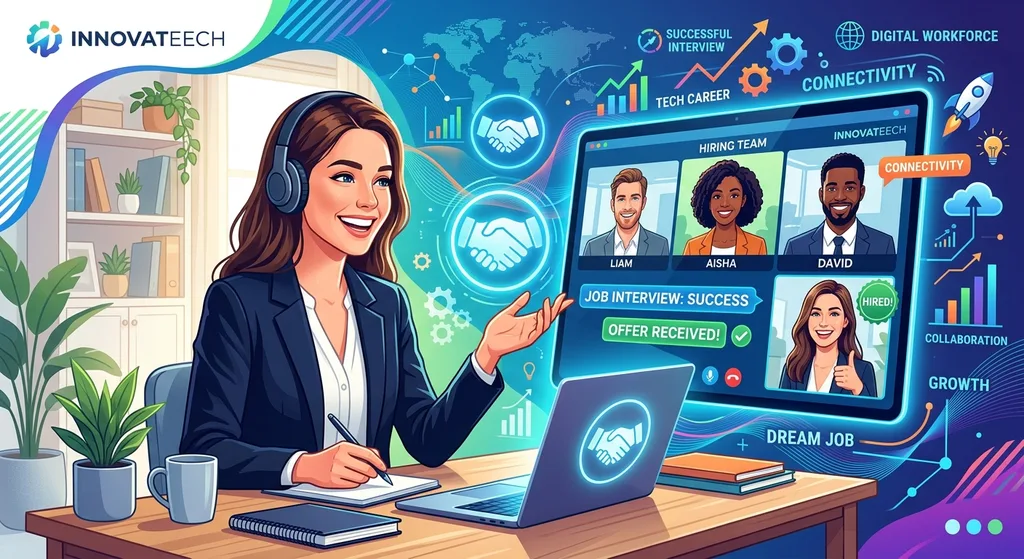
With remote and hybrid work becoming the standard, there is a strong chance your interview will take place over video. Strategic interview preparation requires treating a virtual interview with the exact same level of professionalism as an in-person meeting, while also managing the unique technical variables.
- Master Your Environment: Choose a quiet, well-lit room. Position your primary light source behind your camera, shining onto your face. Ensure your background is clean and professional.
- Check Your Tech: Test your internet connection, microphone, and webcam 24 hours before the interview, and again 30 minutes before.
- The Eye Contact Illusion: In a virtual interview, looking at the interviewer's face on your screen means you are looking down. To make true eye contact, you must look directly into the lens of your webcam while you are speaking.
- Digital Cheat Sheets: One of the main advantages of a virtual interview is that you can have notes nearby. Place sticky notes around the perimeter of your monitor with your core STAR-L stories, key questions to ask, and the interviewer's names. Just be sure to glance at them naturally rather than reading from them directly.
The Night Before and the Day Of
When the night before the interview arrives, your strategic preparation phase should be entirely complete. Trying to cram more information into your brain at the last minute will only spike your anxiety.
Instead, focus on setting yourself up for physical and mental success:
- Lay Everything Out: Choose your interview outfit, print copies of your resume (if in person), and organize your portfolio.
- Visualize Success: Spend five minutes doing a simple visualization exercise. Close your eyes and picture yourself walking into the room (or logging onto the call) feeling calm, smiling naturally, and answering questions with ease.
- Protect Your Sleep: A well-rested brain is significantly better at recalling information and reading social cues. Prioritize getting a full night's sleep.
On the day of the interview, engage in activities that keep you grounded. Listen to your favorite uplifting playlist, do some light stretching, or practice deep breathing exercises. Remember to breathe in deeply through your nose for four seconds, hold for four seconds, and exhale slowly through your mouth for six seconds. This physiological reset will calm your nervous system.
Moving Forward with Unshakeable Confidence
Strategic interview preparation is the most profound gift you can give to your future self. By taking the time to deconstruct the role, craft a compelling career narrative, master your behavioral stories, and practice with intention, you are completely removing the guesswork from the interview process.
You are no longer walking into a room hoping to survive an interrogation. You are walking into a collaborative meeting as a prepared, self-aware professional ready to discuss how you can bring immense value to their organization.
Remember, the hiring manager wants you to be the right person. They want their search to be over. Through strategic preparation, you are simply showing them that they have finally found what they are looking for. Keep moving forward, trust in the hard work you have done to prepare, and step into your next interview ready to claim the career opportunity you truly deserve.