Empowering Autonomy: A Guide to Self-Determination Theory in Your Career

The modern job search can feel like a high-stakes, low-reward game. You pour hours into applications, only to feel like another number in a sea of candidates, your unique value lost in the digital shuffle. This cycle of burnout leaves many professionals searching for a new approach. What if you could reclaim control and transform this process? The key lies in Empowering Autonomy: Guided by Self-Determination Theory (SDT), a powerful framework for finding intrinsic motivation and a career that truly fits.
This guide moves beyond generic advice. We will show you how to strategically apply the core principles of SDT-Autonomy, Competence, and Relatedness-to your job search. You’ll learn to articulate your skills with unshakable confidence, identify company cultures where you feel you belong, and turn the hunt for a job into a fulfilling journey of self-discovery. Get ready to stop just applying for jobs and start architecting a career that energizes and rewards you, long after you land the role.
What is Self-Determination Theory (And Why Should Job Seekers Care?)
The modern job search is a marathon that tests your resilience. If you've ever felt your motivation drain after sending countless applications into the void, you know it’s not a question of willpower. It's a question of strategy. The secret isn't to just push harder; it's to create the conditions for motivation to flourish, a process we call Empowering Autonomy: Guided by Self-Determination Theory (SDT).
This is where a powerful psychological framework comes into play. Developed by psychologists Edward Deci and Richard Ryan, Self-determination theory (SDT) argues that high-quality, sustainable motivation isn't forced-it’s unlocked. For job seekers, understanding this is a game-changer. It’s the difference between a frustrating, reactive search and a proactive, strategic mission. This guide is about Empowering Autonomy: Guided by Self-Determination Theory (SDT) to transform your career hunt.
The 3 Universal Psychological Needs
SDT proposes that all humans, regardless of culture, are driven by three innate psychological needs. When these are met, we feel engaged and motivated. When they are frustrated, our performance and well-being suffer. Applying the framework of Empowering Autonomy: Guided by Self-Determination Theory (SDT) helps you use these needs as your internal compass:
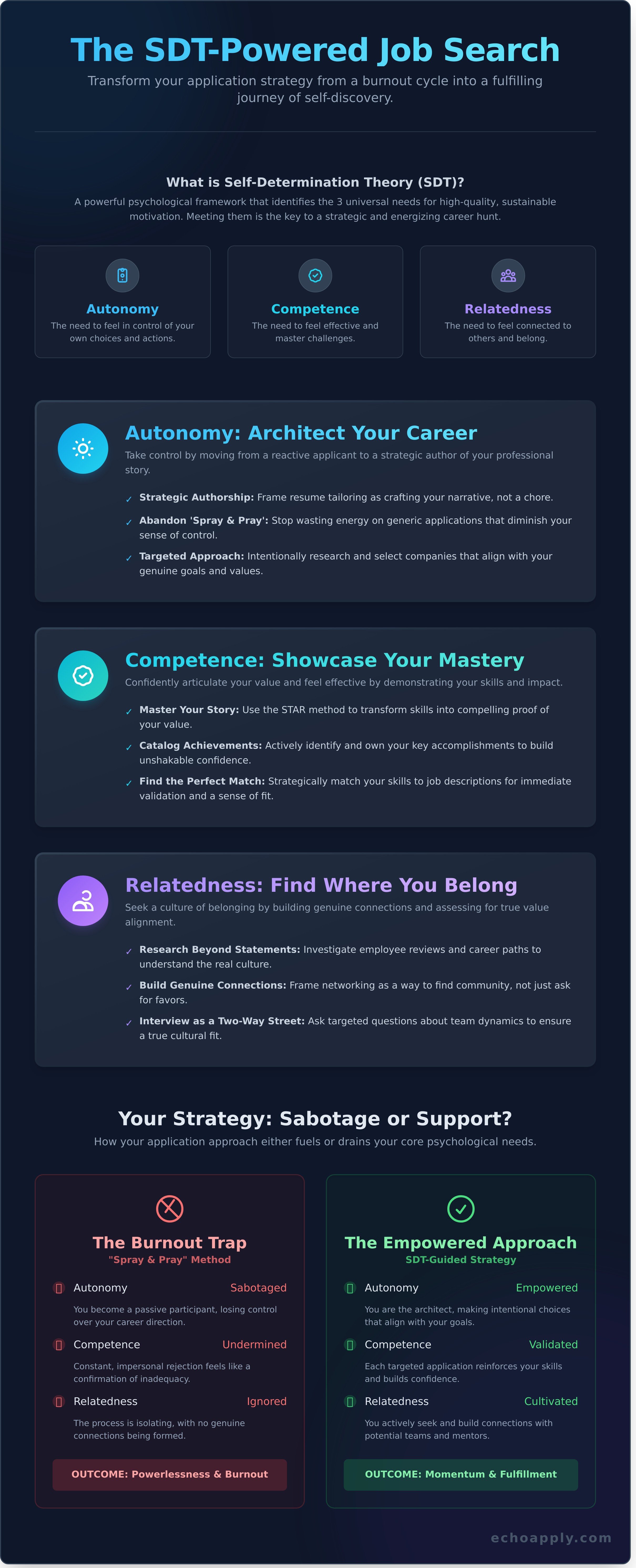
- Autonomy: The need to feel in control of your own choices and actions. As the core principle in Empowering Autonomy: Guided by Self-Determination Theory (SDT), this means you are the architect of your career path, not just a passenger.
- Competence: The need to feel effective, master challenges, and build skills. You want to know your efforts are making a real impact.
- Relatedness: The need to feel connected to others, to care for them, and feel cared for. You seek a workplace where you belong.
Moving Beyond Carrots and Sticks
For decades, motivation was seen as a simple transaction: do this, get that. This "carrot and stick" model relies on extrinsic motivation-external rewards like a high salary, a prestigious title, or a corner office. While important, these rewards alone don't lead to lasting fulfillment.
SDT highlights the critical role of intrinsic motivation, which comes from within. This is the drive you feel when you're genuinely interested in a task, when the work aligns with your personal values, or when you experience a sense of purpose. The ultimate career goal isn't to abandon extrinsic rewards, but to find a role where your intrinsic drivers and extrinsic needs align perfectly. Achieving this alignment is the true power of Empowering Autonomy: Guided by Self-Determination Theory (SDT).
The 3 Pillars of SDT in the Modern Job Search
The modern job search can feel disempowering. But by applying a psychological framework, you can transform it into a strategic, motivating journey. The key lies in focusing on the three core psychological needs that drive human motivation. Empowering Autonomy: Guided by Self-Determination Theory (SDT) provides a roadmap to not just find a job, but to find the right job where you can thrive.
Autonomy: Crafting Your Professional Narrative
Autonomy is the need to feel in control of your own actions and destiny. Instead of viewing resume tailoring as a tedious chore, frame it as a strategic act of authorship. You are choosing precisely how to present your professional story to a specific audience. This proactive approach means abandoning the 'spray and pray' method-a tactic that diminishes your sense of control and wastes valuable energy. By intentionally targeting companies that align with your goals, you move from a reactive applicant to a strategic career architect.
Competence: Showcasing Your Mastery and Value
Competence is the feeling of being effective and capable in your pursuits. In the job search, this translates to confidently articulating your value. Start by identifying and cataloging your key skills and achievements. This isn't just about listing them; it's about owning them.
- Master Your Story: Use interview preparation to build confidence. Rehearsing answers using the STAR method (Situation, Task, Action, Result) transforms abstract skills into compelling proof of your mastery.
- Find the Perfect Match: Strategically matching your skills to the requirements in a job description provides immediate validation, fulfilling the need to feel competent and well-suited for the role.
Relatedness: Finding a Culture Where You Belong
Relatedness is our innate desire to connect with and care for others. Professionally, this means finding a culture of belonging where your values are shared and respected. Go beyond a company's mission statement; research employee reviews, look at the career paths of current team members, and frame networking as building genuine connections, not just asking for favors. Understanding how to assess this is crucial, as research on the future of work with self-determination theory highlights the increasing importance of psychological needs in hybrid and remote settings. Use the interview as a two-way street-ask targeted questions about team dynamics and communication styles to ensure a true cultural fit.
How Your Application Strategy Supports (or Sabotages) Your Motivation
Your job search is more than a series of tasks; it’s a psychological journey. The strategy you choose directly impacts your drive by either fueling or draining your core needs for autonomy, competence, and relatedness. A successful approach is about more than just volume-it's about adopting a mindset focused on Empowering Autonomy: Guided by Self-Determination Theory (SDT).
Let's contrast two fundamentally different approaches and see how one leads to burnout while the other builds unstoppable momentum.
The Burnout Trap of Generic Applications
The "spray and pray" method, where you send the same generic resume to dozens of listings, is a direct assault on your motivation. This high-volume, low-effort tactic robs you of your autonomy, turning you into a passive participant in your own career. Each rejection feels less like feedback and more like a confirmation that you have no control. This cycle actively undermines your sense of competence and leads to:
- A feeling of powerlessness: You're waiting for luck, not creating opportunities.
- Diminished self-worth: Constant silence and rejection make you question your skills.
- Rapid job search fatigue: The repetitive, unfulfilling process quickly becomes exhausting.
The Empowerment of Strategic Tailoring
Conversely, treating each application as a strategic, tailored submission is a powerful act of self-determination. When you analyze a job description and meticulously align your resume and cover letter, you are exercising control and demonstrating your expertise. This isn't just about appeasing an algorithm; it's about proving your competence to yourself first. This strategic act transforms the job search from a game of chance into a demonstration of your value, a key component in the Facilitation of Intrinsic Motivation and long-term career satisfaction. This is the essence of Empowering Autonomy: Guided by Self-Determination Theory (SDT) in practice, leading to higher-quality interviews and a renewed sense of purpose.
Modern technology can be a powerful ally or a dangerous enabler in this process. While "easy apply" buttons can lure you into the burnout trap, intelligent AI tools can accelerate strategic tailoring, allowing you to create perfectly customized applications at scale. The choice is yours: will your tools automate fatigue or empower your ambition?
Leveraging AI to Foster Self-Determination
Many view AI as a tool for generic, soulless output. But what if we reframe it as a strategic partner? Instead of replacing your unique voice, modern AI can amplify it, handling the repetitive tasks that drain your motivation. This shift is central to Empowering Autonomy: Guided by Self-Determination Theory (SDT), where technology becomes a catalyst for human potential, not a substitute for it. By delegating the grunt work, you free up invaluable time and mental energy for high-impact activities like strategic networking and deep research.
AI as Your Competence-Building Assistant
True competence is about both having the skills and being able to articulate them confidently. AI excels here. It acts as an intelligent mirror, reflecting your strengths back to you in the context of a specific role. An advanced AI can:
- Instantly analyze a job description and cross-reference it with your CV, highlighting your most relevant skills and experiences.
- Generate tailored talking points for interviews, helping you practice and master the art of showcasing your value.
- Identify potential skill gaps, giving you a clear roadmap for professional development.
Automating the Tedious, Amplifying Your Autonomy
Nothing drains your sense of control faster than the endless cycle of writing customized applications. This is where AI restores your autonomy. By generating a powerful first draft of a tailored cover letter, it eliminates blank-page paralysis and saves hours of work. At EchoApply, we ensure this process is rooted in your authentic self. Our platform pulls from your personal Identity Vault-a secure repository of your unique achievements, skills, and career stories. The AI doesn't invent; it articulates your truth, perfectly tailored. This is the essence of Empowering Autonomy: Guided by Self-Determination Theory (SDT) at work. You direct the strategy while your AI partner handles the execution.
Ready to transform your job search? Build your Identity Vault and start creating applications that truly echo you.
Putting It All Together: Your Self-Determined Career Action Plan
Understanding the theory is the first step; translating it into action is where you gain a competitive edge. It’s time to shift your mindset from merely finding a job to strategically architecting a career that fulfills your core psychological needs. This is the essence of Empowering Autonomy: Guided by Self-Determination Theory (SDT). Stop reacting to the job market and start proactively shaping your professional future with a clear, actionable plan.
Audit Your Job Search Through an SDT Lens
Before you apply for another role, perform a quick diagnostic on your current process. This internal audit helps you reclaim control and focus your energy where it matters most. Ask yourself these critical questions:
- Autonomy: Where do I feel a lack of control in my job search, and what is one change I can make to own that step?
- Competence: What single action can I take today-like refining a skill on my resume or researching a new industry-to feel more capable and confident?
- Relatedness: How can I research a company’s culture or connect with a potential team member on LinkedIn to better assess my potential connection before I apply?
Vet Opportunities for Autonomy, Competence, and Relatedness
Your interview is not just an evaluation of your skills; it's your opportunity to gather intelligence. Use it to determine if a role aligns with your SDT needs. Go beyond standard questions and probe for what truly drives motivation:
- For Autonomy: "Can you describe the team's approach to project ownership? How are key decisions made, and what level of independence is typical for someone in this role?"
- For Competence: "What does the onboarding process look like, and what formal or informal opportunities are there for professional development and skill-building?"
- For Relatedness: "How does the team celebrate wins and support each other during challenges? What are the core values that guide your daily collaboration?"
Your career is too important to leave to chance. By applying this framework, you transform your job search from a numbers game into a strategic mission for fulfillment. This proactive approach is central to Empowering Autonomy: Guided by Self-Determination Theory (SDT). When you intentionally seek roles that nurture your needs for autonomy, competence, and relatedness, you don’t just land a job-you unlock lasting motivation and build a career that truly energizes you. Accelerate your strategic search and build winning applications that reflect your true potential with the intelligent tools at EchoApply. Your career, echoed perfectly.
Your Self-Determined Career, Echoed Perfectly
The journey to a fulfilling career is not about chasing trends; it's about building a path that honors your intrinsic needs. By embracing the core principles of autonomy, competence, and relatedness, you transform your job search from a reactive chore into a proactive mission. This journey of Empowering Autonomy: Guided by Self-Determination Theory (SDT) gives you the framework to stop being a passive applicant and become the strategic architect of your professional life.
But strategy requires the right tools. Don’t let the grind of generic applications sabotage your motivation. It’s time to leverage technology that works for you, amplifying your unique strengths and accelerating your goals. Trusted by job seekers to transform their career journey, EchoApply is your strategic partner in this mission. Leverage your personal 'Identity Vault' for perfectly tailored applications and go beyond generic advice with strategic, AI-powered interview prep.
The future of your career isn't just something you find; it's something you build. Start building today.
Empower your job search with AI. Discover EchoApply today.
Frequently Asked Questions
How can I stay motivated when my main driver for a new job is a higher salary?
A higher salary is a powerful external motivator. To sustain drive long-term, pair it with intrinsic goals. Once in the role, focus on mastering new skills (Competence), building strong team connections (Relatedness), and seeking ownership over your projects (Autonomy). Use the financial security as a foundation to pursue work that genuinely engages you, transforming the job into more than just a paycheck. This strategic approach ensures lasting career satisfaction and high performance.
What are some red flags during an interview that a company won't support my autonomy?
Watch for signs of micromanagement. Red flags include the interviewer overemphasizing rigid processes, asking how you handle "constant supervision," or being vague about your decision-making power. If they can't clearly define how success is measured beyond just "following instructions," it signals a lack of trust. A culture of true Empowering Autonomy: Guided by Self-Determination Theory (SDT) focuses on results, not rigid control, making a focus on the latter a major warning.
Can Self-Determination Theory help me decide between two different job offers?
Absolutely. Use SDT as a strategic framework to compare the offers beyond salary. Analyze which role offers greater Autonomy (more control over your work), Competence (better opportunities for growth and mastery), and Relatedness (a team culture where you feel you'll belong). Weigh these factors to determine which position will provide more sustainable, long-term motivation. A slightly lower salary might be worth it for a massive boost in these three core psychological needs.
Is it possible to feel 'relatedness' in a fully remote job?
Yes, but it requires deliberate action. Strong remote teams foster relatedness through intentional communication. This includes using video calls to see facial cues, creating dedicated non-work channels for social chat, and scheduling virtual team-building activities. Clear, consistent, and empathetic communication from leadership is key. It’s about building a sense of shared purpose and psychological safety, proving that connection isn't limited by physical location.
How do I find my intrinsic motivations if I'm not sure what they are?
To discover your intrinsic drivers, analyze your past. Reflect on projects where you lost track of time-what were you doing? Identify skills you enjoy practicing, even if no one is watching. Think about problems you feel a genuine pull to solve. These moments of "flow" and natural curiosity are your signposts. Document them to build a clear picture of what truly energizes you, creating a powerful asset for your career strategy.
Won't using an AI tool like EchoApply make my application less authentic?
EchoApply doesn't create a false you; it empowers the real you. Your skills, experiences, and career goals-stored in your personal Identity Vault-are the foundation. The AI acts as a strategic coach, helping you articulate that authentic information perfectly for each specific job description. It eliminates the tedious, repetitive work, allowing you to focus your energy on showcasing your genuine value in the most compelling and targeted way possible. It’s your career, echoed perfectly.