How to Use a Job Description to Write a Resume That Gets Interviews

Are you tired of sending your resume into a digital black hole, only to be met with frustrating silence? You know you’re qualified, but your applications disappear without a trace, screened out before a human ever sees them. The problem isn’t your experience-it’s that your resume isn’t speaking the right language. The secret to getting noticed is hidden in plain sight. Learning how to strategically use the job description for resume creation is the most powerful way to beat the bots and capture a recruiter’s attention.
This guide will empower you with a smarter, faster strategy. We’ll show you how to instantly decode any job post, pinpoint the critical keywords that unlock interviews, and tailor a winning resume in minutes, not hours. Stop guessing what companies want. It’s time to build an application that commands attention and lands you in the interview chair, accelerating your career with total confidence.
Why the Job Description Is Your Secret Weapon for a Winning Resume
Stop sending the same generic resume for every application. In today's competitive job market, that strategy is obsolete. Think of the job description not as a wish list, but as the answer key to the test. It contains the exact skills, qualifications, and keywords that hiring managers and their software are programmed to find. While the fundamental purpose of what is a resume-to summarize your professional value-remains the same, the method for getting it seen has been transformed by technology.
Moving from a one-size-fits-all approach to a targeted, strategic one is the single most effective way to accelerate your job search. By meticulously analyzing the job description for resume alignment, you empower yourself to bypass digital gatekeepers and capture human attention instantly. This is how you gain your competitive advantage.
Beating the Applicant Tracking System (ATS)
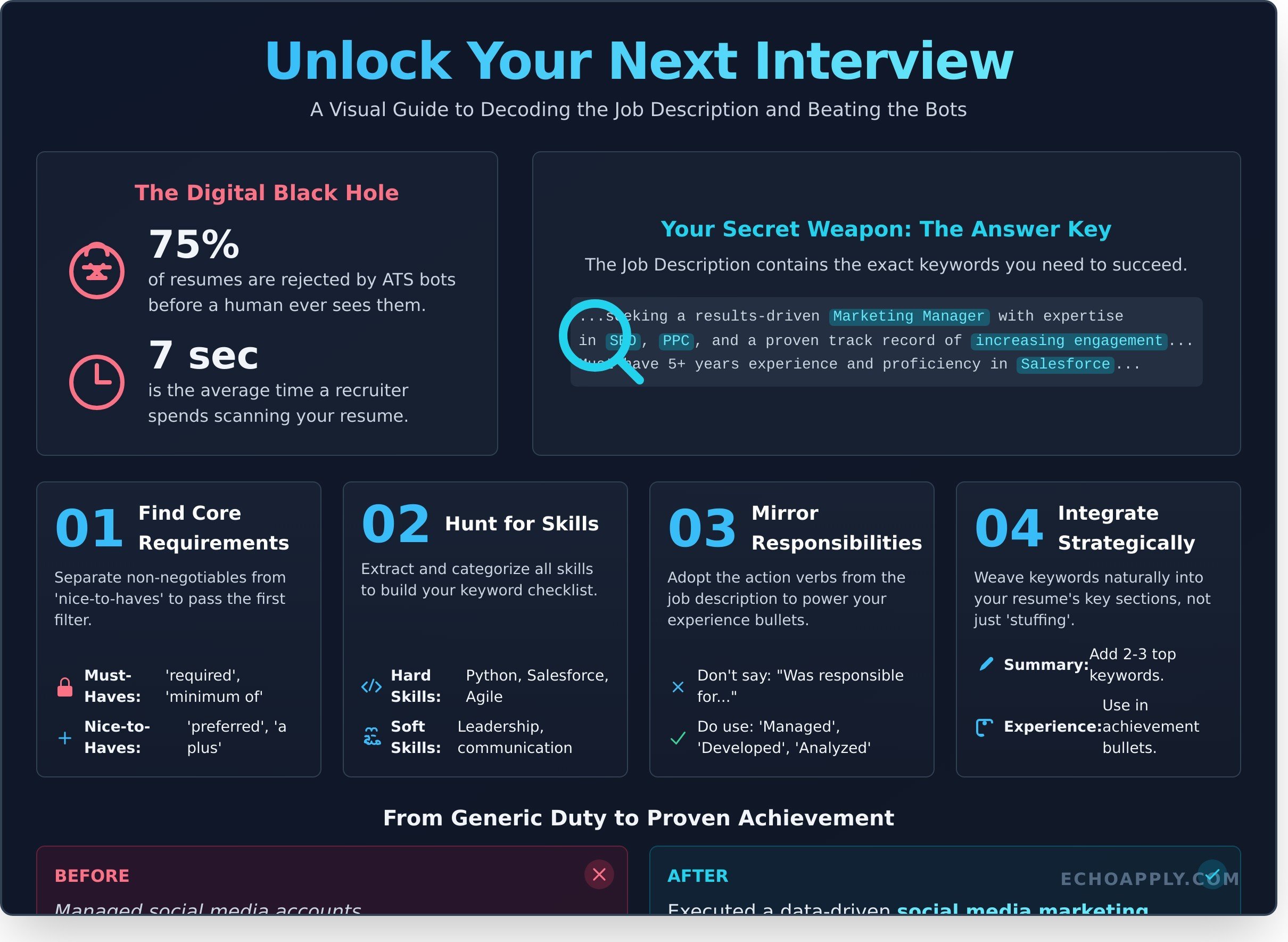
Your first reader is almost never a person. It’s an Applicant Tracking System (ATS)-intelligent software that scans, sorts, and scores your application. Shockingly, as many as 75% of resumes are rejected by an ATS before a human ever sees them. This system works by matching the keywords in your resume against the keywords in the job description. Your goal is simple: achieve a high match score by strategically echoing the company's language.
Speaking the Recruiter's Language
Once you pass the ATS, you have seconds to make an impression. Studies show that recruiters spend an average of just seven seconds on their initial scan of a resume. In that brief window, they are hunting for specific keywords that prove you are a qualified fit. A tailored resume immediately signals that you are a serious, detail-oriented candidate who has invested time in the application. You make their job easier, which makes them far more likely to move you to the "interview" pile.
A 4-Step Method to Decode Any Job Description
Stop guessing what recruiters want and start strategizing. A job description isn't just a list of duties; it's a strategic blueprint for your winning application. This systematic method empowers you to decode any role, transforming a dense wall of text into an actionable roadmap. Grab a highlighter or open your digital annotation tool. We're about to turn the challenge of analyzing a job description for resume optimization into a decisive advantage by focusing on four key areas: requirements, skills, responsibilities, and culture.
Step 1: Identify Core Requirements vs. 'Nice-to-Haves'
First, you must separate the non-negotiables from the bonus points. This is a critical step for passing automated screens. Scan for definitive phrases like ‘must have,’ ‘required,’ or ‘minimum qualifications.’ These are the gatekeeper keywords for the Applicant Tracking System (ATS). Then, identify the ‘nice-to-haves’ signaled by words like ‘preferred,’ ‘a plus,’ or ‘bonus points.’ Your core requirements must be featured prominently and clearly in your resume to guarantee you make it to the next stage.
Step 2: Hunt for Hard and Soft Skill Keywords
Every job description is a goldmine of skill keywords. Your mission is to extract them all and build a strategic checklist. Create a simple document and categorize every skill you find:
- Hard Skills: These are the teachable, often technical, abilities the role demands. Look for specific software (Salesforce, Adobe Creative Suite), programming languages (Python, Java), or methodologies (Agile, Scrum).
- Soft Skills: These are the interpersonal traits that define how you work and collaborate. Hunt for terms like leadership, strategic communication, problem-solving, and teamwork.
This targeted list becomes the foundation for tailoring your resume’s skills section and experience bullets.
Step 3: Analyze the 'Day-to-Day' Responsibilities
This section is where you find the language of the role. It details what you will actually be doing and provides the action-oriented phrases to power your work experience bullet points. Pay close attention to the specific verbs they use-‘manage,’ ‘develop,’ ‘analyze,’ or ‘implement.’ Using their exact phrasing proves you can perform the job effectively from day one. Mirroring their language is a powerful strategy, a core principle backed by countless expert resume writing tips. This is how you show, not just tell, that you are the perfect candidate for the job.
How to Weave Job Description Keywords Into Your Resume
You've analyzed the job description and extracted the critical keywords. Now it’s time to transform that intelligence into a resume that demands attention. The goal is strategic integration, not just "keyword stuffing." Your resume must sound authentic and compelling to a human reader while satisfying the Applicant Tracking System (ATS). Think of it as mirroring the company's language to show you're a perfect fit, and then proving it with powerful, quantifiable achievements. This is how you use a job description for resume optimization to gain a competitive edge.
Optimize Your Resume Summary
Your resume summary is your 15-second elevator pitch. Place this 2-3 sentence power statement at the top of your resume to immediately capture a recruiter’s interest. Weave in 2-3 of the most vital keywords you identified-typically those related to core competencies or years of experience. Tailor this section for every single application you submit to ensure it aligns perfectly with the role's top priorities.
Craft Achievement-Oriented Work Experience
Move beyond listing duties. Instead, showcase your impact using achievement-oriented bullet points. The STAR method (Situation, Task, Action, Result) is an excellent framework for this. Incorporate keywords naturally as you describe your accomplishments, focusing on the results you delivered. Rephrasing your past experience to align with the role is critical. This approach aligns with expert advice from government resources like USAJOBS, which stresses the importance of your ability to tailor your resume to the job announcement by proving you meet each listed qualification.
- Instead of: Managed social media accounts.
- Try: Executed a data-driven social media marketing strategy across three platforms, increasing audience engagement by 25% in six months.
Build a Targeted Skills Section
A dedicated skills section gives both the ATS and the hiring manager a quick, scannable checklist of your qualifications. List the most relevant hard skills and software proficiencies you found in the job description for resume analysis. It is crucial to use the exact terminology from the posting. If the company lists "Salesforce CRM," your resume should say the same, not just "CRM software." This precision eliminates any guesswork and ensures your capabilities are instantly recognized.
By strategically placing these keywords, you’re not just optimizing for algorithms; you're crafting a compelling career narrative. To accelerate this process and generate a perfectly tailored resume in seconds, explore the power of EchoApply.
The Smart Way: Use AI to Match Your Resume to a Job Description
Manually tailoring your resume is effective, but it’s a bottleneck in your job search. The process is incredibly time-consuming, and it’s far too easy to miss subtle keywords or misinterpret the hiring manager's priorities. In a competitive market, spending hours on a single application is a strategic disadvantage.
This is where top candidates create their edge. Instead of manual guesswork, they leverage AI to instantly analyze and optimize their application materials. This technology transforms the tedious task of matching a job description for resume optimization from an art into a science.
From Hours to Seconds: How AI Analyzes Documents
AI-powered platforms don’t just scan for keywords; they perform a comprehensive strategic analysis in seconds. The software simultaneously deconstructs the job description and your resume, identifying the critical skills, qualifications, and action verbs that Applicant Tracking Systems (ATS) and recruiters are programmed to find.
- Instant Gap Analysis: The AI immediately highlights crucial skills and requirements from the job post that are missing from your resume.
- Keyword Identification: It pinpoints high-value keywords and phrases you may have overlooked, ensuring you speak the employer’s language.
- Data-Driven Feedback: You receive an objective, data-backed score of how well your resume matches the role, removing all guesswork from the equation.
Generate Tailored Content Instantly
True optimization goes beyond simple analysis. Platforms like EchoApply use your core resume to create a personalized ‘Identity Vault’-a dynamic database of your skills and accomplishments. From there, the AI doesn't just give you suggestions; it generates perfectly tailored content for you.
It crafts powerful, achievement-oriented bullet points and professional summaries that naturally integrate the most important keywords. This ensures every line of your resume is strategically aligned with the job description for resume alignment, presenting your experience in the most impactful way possible.
Gain Your Competitive Edge
Stop guessing what recruiters want to see and start giving it to them with precision. By automating the most time-consuming part of applying, you unlock a powerful competitive advantage. You can apply to more relevant jobs in a fraction of the time, all with superior, highly-targeted applications that command attention.
Focus your valuable time and energy on what truly matters: preparing for the flood of interviews you’ll now be getting. Let EchoApply tailor your resume perfectly for your next job.
Your Blueprint for an Interview-Winning Resume
The job description is no longer just a list of requirements; it’s your strategic blueprint for success. By meticulously decoding its language and weaving its specific keywords into your qualifications, you transform your application from a generic document into a powerful, targeted pitch. This strategic use of the job description for resume customization is what separates candidates who get noticed from those who get overlooked.
But manually tailoring every application is time-consuming. Why leave it to chance when you can have precision and speed? EchoApply’s AI-powered platform analyzes any job description to instantly generate perfectly tailored resumes and cover letters. It’s your strategic advantage in a competitive market.
Stop guessing. Let EchoApply generate your winning resume in seconds. Your career, echoed perfectly. Your next great opportunity is waiting.
Frequently Asked Questions
Should I copy and paste phrases directly from the job description?
Avoid directly copying phrases. While tempting, both applicant tracking systems (ATS) and human recruiters can easily spot this, which undermines your credibility. Instead, strategically integrate keywords into your own achievement-based bullet points. Rephrase the requirements to reflect your unique experiences and accomplishments. This transforms your resume from a generic copy into a powerful, tailored document that authentically proves you are the perfect fit for the role and its challenges.
What is keyword stuffing and how can I avoid it on my resume?
Keyword stuffing is the practice of unnaturally overloading your resume with keywords, often in a long list or hidden in white text. This outdated tactic fails with both modern ATS and human readers. To avoid it, focus on context. Weave keywords into descriptions of your actual accomplishments. For example, instead of listing "project management," describe how you "led a cross-functional project management initiative that increased efficiency by 15%." Quality always wins over quantity.
How do I include keywords for skills I'm still developing or learning?
Showcase your ambition and commitment to growth by being transparent. Create a dedicated section on your resume titled "Professional Development" or "Continuing Education." Here, you can list skills or certifications you are actively pursuing, such as "In progress: Google Project Management Certificate." This strategy allows you to include relevant keywords while honestly framing them as developing competencies, demonstrating a proactive and forward-thinking mindset to potential employers.
Does this resume tailoring strategy work for career changers?
Absolutely. For career changers, this strategy is not just helpful-it’s essential. Tailoring your resume helps you build a bridge from your past experience to your future career. By strategically using keywords from the new industry's job description, you can reframe your transferable skills in a language that recruiters will understand and value. This alignment accelerates your transition by proving your potential and demonstrating that you are a serious, well-prepared candidate for the role.
How many keywords from the job description should I aim to include?
Focus on precision, not just volume. There is no magic number, as blindly adding terms leads to keyword stuffing. Instead, analyze the posting and identify the 5-10 most critical keywords related to core responsibilities, skills, and qualifications. Integrating these high-impact terms is the most strategic way to use a job description for resume optimization. This ensures your application is tailored for maximum impact, resonating with both automated systems and the hiring manager.
What if my past job titles don't match the one in the description?
Never change your official job title, as this can be seen as dishonest during a background check. Instead, you can strategically add a functional or descriptive title in parentheses to provide context. For example: "Operations Manager (equivalent to Senior Project Lead)." You can also use your professional summary at the top of your resume to immediately frame your experience and align your qualifications with the target role’s title and its core functions.