How to Write an Internship Cover Letter That Gets You Hired (With Examples)

Staring at a blank page, trying to translate your potential into a professional letter with no “real” work experience? The pressure to impress, the confusing formatting rules, and the fear of your application getting lost in the crowd can be paralyzing. Writing a compelling internship cover letter feels like a monumental task when you’re just starting out, but it’s the single best tool you have to showcase your ambition and unique skills.
This is where you stop guessing and start winning. This guide provides the strategic blueprint you need to write a letter that truly stands out. We'll give you a clear, step-by-step framework to follow, expert techniques to highlight your academic achievements, and proven examples that you can adapt instantly. Get ready to transform your potential into a confident narrative that opens doors, lands you the interview, and accelerates your career.
Before You Write: The 3-Step Internship Application Strategy
A winning internship cover letter isn’t about listing decades of experience-it’s about strategically showcasing your potential. Hiring managers for interns aren't looking for a finished product; they are investing in future talent. This essential 3-step preparation empowers you to move from uncertainty to action, making the writing process faster, smarter, and far more effective.
Before you type a single word, execute this strategy to build a powerful foundation for your application.
Step 1: Decode the Internship Description
Move beyond a quick scan. Actively mine the internship description for intelligence. Your goal is to identify the company’s exact needs and mirror their language. Isolate the top 3-5 keywords and skills they mention repeatedly-like "data analysis," "project management," or "content creation." Look deeper for cultural clues. Words like “fast-paced,” “highly collaborative,” or “mission-driven” are your roadmap to proving you are a perfect fit.
Step 2: Inventory Your 'No-Experience' Assets
You have more valuable experience than you think. The key is to reframe it. Create a master list of your assets by thinking beyond traditional job titles. This inventory becomes the raw data for your tailored application.
- Academic Achievements: List relevant coursework, lab work, and major projects. Did you write a research paper on a related topic? Add it.
- Transferable Skills: That part-time retail job taught you customer communication, problem-solving under pressure, and time management. Frame it professionally.
- Extracurriculars & Projects: Include leadership roles in clubs, volunteer experience, or personal coding projects. These demonstrate initiative and passion.
Step 3: Understand What Recruiters *Actually* Want
Recruiters know you're a student. Beyond understanding the basic structure of what a cover letter is, you need to grasp the psychology of what makes an intern valuable. They are screening for core traits, not a lengthy resume. Focus on demonstrating:
- Enthusiasm and Coachability: Show you are eager to learn, ready to contribute, and open to feedback.
- Genuine Interest: Prove you want this internship, not just any internship. Mention a specific company project, value, or recent news that excites you.
- A Problem-Solving Mindset: Demonstrate how you think. Briefly describe a time you used a skill to solve a challenge in a project or part-time job.
Anatomy of a Winning Internship Cover Letter (Section by Section)
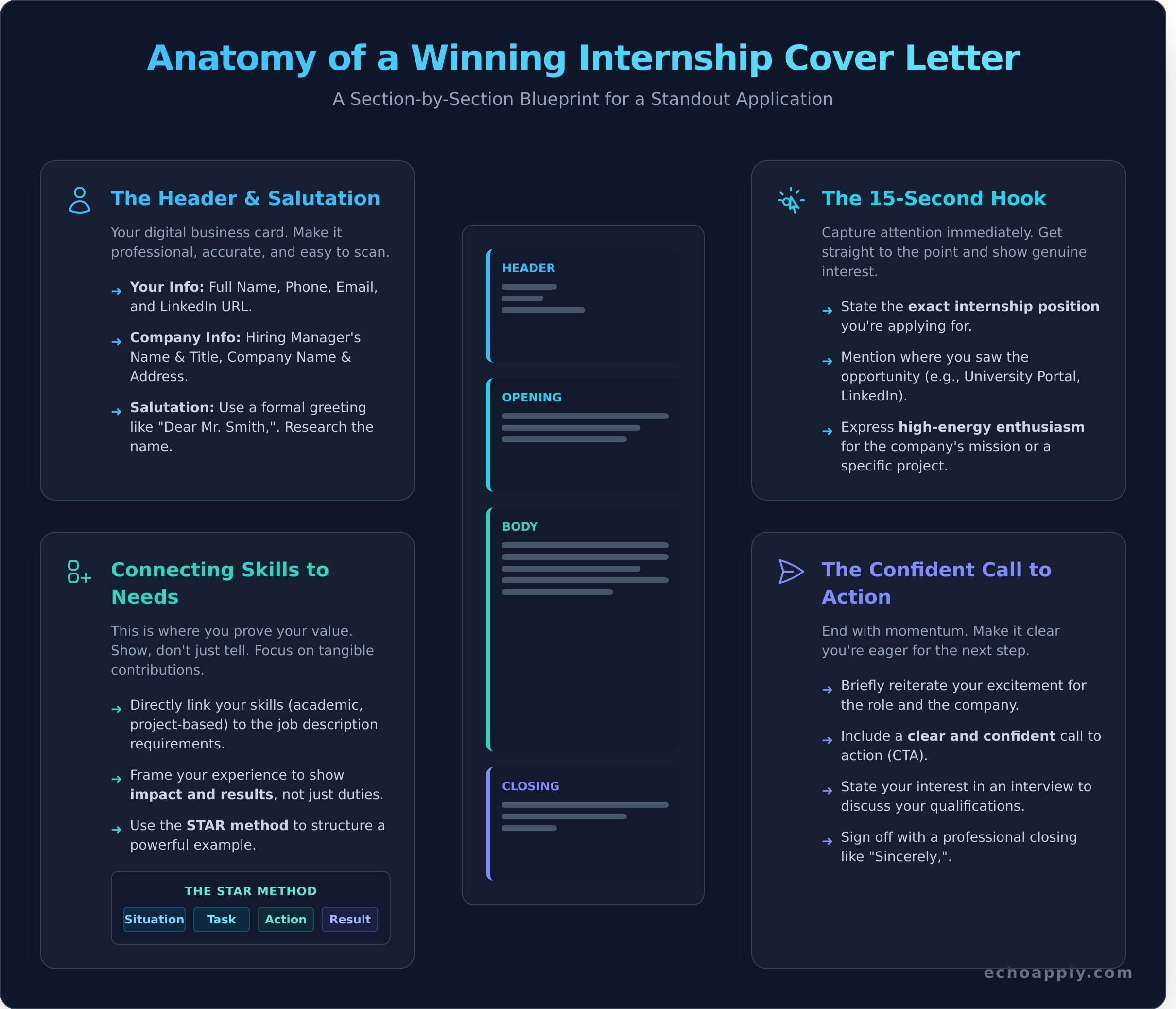
A winning internship cover letter isn’t just about what you say-it’s about how you structure your argument. A powerful structure ensures your message is logical, persuasive, and instantly scannable for a busy hiring manager. Follow this strategic blueprint to build a strong foundation, and you'll see this exact framework reflected in high-quality internship cover letter examples from leading institutions like Columbia University.
The Header and Salutation
Your header is your digital business card. It must be professional, accurate, and easy to read. After your contact details, add the date and the company's information. Always address your letter to a specific person to create an immediate connection. If a name isn't listed, search LinkedIn for "[Company Name] + [Department] Hiring Manager" or check the company's team page.
- Your Contact Info: Full Name, Phone, Email, and LinkedIn URL.
- Company Info: Hiring Manager's Name, Title, Company Name, and Address.
- Salutation: Use a formal greeting like "Dear Mr. Smith," or "Dear Ms. Chen,".
The Opening Paragraph: Your 15-Second Hook
You have seconds to capture the reader's attention. Get straight to the point. State the exact internship position you’re targeting and mention where you discovered the opportunity (e.g., LinkedIn, university career portal). Immediately follow up with a concise, high-energy sentence expressing your genuine enthusiasm for the company’s mission or a specific project. This shows you’ve done your research and are not sending a generic application.
The Body Paragraphs: Connecting Your Skills to Their Needs
This is where you prove your value. In one or two paragraphs, connect your skills and experiences directly to the requirements in the job description. Instead of just listing what you've done, show the impact you made. Use the STAR method (Situation, Task, Action, Result) to frame a specific example from a project or past role. Focus on what you can contribute to their team, transforming your academic experience into a tangible asset for the company.
The Closing Paragraph: The Confident Call to Action
End with confident momentum. Briefly reiterate your excitement for the role and the company. The most critical step is to include a clear call to action-confidently state your interest in discussing your qualifications and how you can contribute to their goals in an interview. Thank the reader for their time and consideration, and sign off with a professional closing like "Sincerely," or "Best regards," followed by your typed full name.
How to Write a Cover Letter with No Experience: 3 Powerful Examples
The single biggest fear for intern applicants is the blank "Work Experience" section. But a lack of formal jobs doesn't mean a lack of qualifications. The key to a powerful internship cover letter is to strategically reframe your existing experiences-academic, part-time, and extracurricular-as valuable professional assets. Stop seeing a gap; start seeing potential. These examples show you how to translate your background into a compelling narrative that showcases your drive, skills, and readiness to contribute from day one.
Example 1: Leveraging a Major Academic Project
For a software engineering internship, your coding projects are your experience. Instead of just listing the project, describe the challenge and your specific contribution. Frame it as a professional accomplishment that demonstrates both technical and soft skills.
"In my Advanced Algorithms course, I collaborated in a three-person team to develop a Python-based logistics optimization tool that reduced hypothetical delivery routes by 15%. My role focused on developing the user interface and debugging the pathfinding module."
- Skills Showcased: Python, Team Collaboration, Problem-Solving, UI Development.
Example 2: Highlighting Transferable Skills from a Part-Time Job
Applying for a marketing internship with only retail experience? Perfect. Your part-time job is a goldmine of transferable skills. Connect your daily tasks to the core competencies of a marketing role, moving from "cashier" to "customer relations specialist."
"During my two years at Urban Outfitters, I consistently exceeded sales targets by actively engaging customers to understand their needs. I also assisted with weekly inventory management, analyzing sales data to identify fast-moving products and inform visual merchandising decisions."
- Skills Showcased: Communication, Sales, Customer Relationship Management, Data Analysis.
Example 3: Showcasing Passion Through Extracurriculars
When applying to a non-profit, passion and initiative are just as important as paid experience. A leadership role in a relevant student club or volunteer group demonstrates commitment and project management skills that employers value highly.
"As President of the campus Environmental Action Club, I spearheaded our 'Green Week' initiative, organizing a 5-day event series that increased student engagement by 40%. This involved coordinating with 10+ volunteers, managing a small budget, and securing speakers, demonstrating my commitment to your mission."
- Skills Showcased: Leadership, Project Management, Event Planning, Community Outreach.
Accelerate Your Internship Applications with AI
Writing an internship application can be a slow, repetitive process. You know that tailoring each internship cover letter is critical, but the effort required can be draining, pulling your focus away from what truly matters: networking, preparing for interviews, and building your professional brand. The time spent staring at a blank page is time you could be using to make connections that land you the job.
Modern AI tools are transforming this outdated process. Instead of treating your application as a tedious writing task, you can approach it as a strategic move. By leveraging intelligent technology like EchoApply, you can eliminate writer's block and generate powerful, tailored documents in seconds. Our platform analyzes your resume and the internship description to create a first draft that's already 90% of the way there, empowering you to work smarter, not harder.
Stop Staring at a Blank Page
Writer's block is the enemy of momentum. An AI-powered assistant eliminates the blank page entirely, giving you a powerful head start. Instead of struggling to find the right words to build the perfect application, you can:
- Instantly generate a structured, professional draft based on your unique qualifications.
- Use AI to find compelling language to express your skills and genuine enthusiasm.
- Ensure your letter is optimized to include the key competencies recruiters are looking for.
Tailor Every Application, Effortlessly
A generic cover letter is one of the fastest ways to get your application rejected. Recruiters can spot them instantly, and they signal a lack of genuine interest. But customizing each one takes hours you don't have. AI solves this dilemma by enabling you to tailor your message for every unique internship in seconds, not hours. EchoApply ensures your internship cover letter is always highlighting the most relevant skills and experiences for each specific role, dramatically increasing your chances of getting noticed.
Focus your energy where it counts. Let AI handle the repetitive writing so you can concentrate on interview prep and building valuable industry connections. Your career is too important to be slowed down by tedious tasks.
Try EchoApply's AI cover letter generator and land more interviews.
Final Polish: Formatting, Proofreading, and Sending Your Letter
You’ve crafted a compelling narrative and showcased your potential. But the final 1% of effort makes 99% of the difference. A powerful internship cover letter can be instantly undermined by simple, avoidable mistakes. This final checklist ensures your application is flawless, professional, and ready to make a winning first impression. Don't let a typo cost you a career-defining opportunity.
Professional Formatting Rules That Matter
Before a hiring manager reads a single word, they see your document's structure. A clean, professional layout signals respect for their time and an organized mind. Adopt these non-negotiable standards to immediately convey competence.
- One Page, Maximum: Brevity is a sign of confidence. Keep your letter concise and focused on a single page.
- Clean, Readable Font: Stick to standard, professional fonts like Calibri, Arial, or Times New Roman in a 10-12 point size.
- Standard Margins and Alignment: Use 1-inch margins on all sides and left-align your text for optimal readability.
- Strategic White Space: Avoid dense blocks of text. Use short paragraphs and spacing to create a clean, scannable document that is easy on the eyes.
Your Zero-Tolerance Policy for Errors
Typos and grammatical mistakes are the fastest way to get your application discarded. They signal a lack of attention to detail-a critical flaw for any intern. Adopt a zero-tolerance policy for errors with this three-step review process.
- Read It Aloud: This simple trick helps you catch awkward phrasing and run-on sentences that your eyes might skim over.
- Use a Grammar Checker: Tools like Grammarly are excellent for catching common mistakes, but they aren't foolproof. Use them as a first line of defense, not your only one.
- Get a Second Opinion: Ask a trusted professor, career advisor, or detail-oriented friend to review your letter. A fresh set of eyes can spot errors you’ve become blind to. For an instant, AI-powered review that transforms your draft into a winning application, explore advanced tools at EchoApply.
How to Submit Your Cover Letter
The final step is delivering your document flawlessly. How you save and send your letter reflects your technical proficiency and professionalism. Follow these best practices to ensure your application arrives perfectly.
- Always Send as a PDF: A PDF preserves your formatting across all devices and operating systems. Never send an editable file like a .docx or .pages file.
- Use a Professional File Name: Name your file clearly and professionally. The standard convention is FirstName-LastName-Cover-Letter.pdf (e.g., Jane-Doe-Cover-Letter.pdf).
- Check Email Formatting: If an application requires you to paste your letter into the body of an email, do a final check to ensure all spacing and formatting remained intact before you hit "send."
Your Career Starts Now: Land the Internship
You now have the complete blueprint for success. Remember, a winning application is built on strategic research long before you write a single word. By structuring your letter to highlight your unique value-leveraging academic projects and skills even without formal experience-and meticulously polishing the final draft, you create an unforgettable first impression. A truly exceptional internship cover letter is your chance to stand out from a crowded field and prove you are the right candidate.
This process requires precision, but you don't have to do it alone. It's time to stop writing generic applications and gain a powerful competitive edge. EchoApply is your strategic partner in accelerating your career. Our sophisticated AI analyzes your unique skills and the job description to create perfectly tailored applications in seconds. Move from frustrated applicant to top contender, instantly.
Stop writing generic applications. Generate a winning internship cover letter with EchoApply's AI. Your future starts with this application. Go make it count.
Frequently Asked Questions About Internship Cover Letters
How long should an internship cover letter be?
Aim for precision and impact. Your cover letter should be a concise, powerful pitch-not a novel. Keep it to three or four short paragraphs, totaling between 250 and 400 words. This length is strategic; it respects the hiring manager's time while giving you enough space to showcase your ambition, highlight key skills, and directly connect your potential to the company's needs. Anything longer risks losing their attention before you've made your point.
Do I really need a cover letter if the application says it's optional?
Treat "optional" as "opportunity." Submitting a cover letter when it's not required is a strategic move that immediately differentiates you from less motivated candidates. It’s your chance to demonstrate genuine interest and articulate a compelling narrative that your resume can’t. This extra step shows initiative and a higher level of professionalism, giving you a significant competitive advantage. Don't skip a chance to accelerate your application to the top of the pile.
Who should I address my cover letter to if I can't find a name?
Ditch outdated greetings like "To Whom It May Concern." Your first step is a quick strategic search on LinkedIn or the company website for the hiring manager or department head. If a specific name remains elusive, address it to a title, such as "Dear [Department Name] Hiring Manager" or "Dear [Company Name] Internship Committee." This targeted approach demonstrates resourcefulness and a commitment to detail, making a far stronger first impression than a generic, impersonal salutation.
Is it okay to use a cover letter template?
A template can be an efficient starting point for structure, but it should never be the final product. Generic, copy-pasted content is instantly recognizable and signals a lack of genuine interest. Use templates to guide your format, but ensure the content is 100% tailored to the specific role and company. Your goal is to create a document that echoes your unique qualifications and passion, not to submit a form letter that could have been written by anyone.
What's the biggest mistake to avoid in an internship cover letter?
The most critical mistake is simply summarizing your resume. Your resume lists *what* you've done; your internship cover letter must explain *why* it matters for this specific role. A redundant letter adds no value and wastes the reader's time. Instead, use this space to build a compelling narrative. Connect your experiences to the company's mission, showcase your passion, and articulate the unique value you will bring to their team. Make it a forward-looking, strategic document.
How is an internship cover letter different from a full-time job cover letter?
The strategic focus shifts from past performance to future potential. A full-time job cover letter emphasizes a proven track record and direct experience. An internship cover letter, however, is your platform to showcase enthusiasm, a strong capacity to learn, and transferable skills. You are selling your potential and ambition. Highlight academic projects, relevant coursework, and extracurriculars that demonstrate your drive and alignment with the company’s goals, proving you’re a valuable investment.