The Best Cover Letter Format to Get Hired in 2026

Staring at a blank page, wondering if your cover letter will be instantly rejected by an Applicant Tracking System (ATS)? You’re not alone. In today's hyper-competitive job market, finding the best cover letter format is just as critical as the words you write. An outdated or confusing layout can stop a winning application dead in its tracks before a human ever sees it.
It’s time to move from uncertainty to confidence. This guide is your strategic blueprint for 2026, engineered to make your application stand out. We will demystify the precise structure and layout that impresses both intelligent screening software and the recruiters who hold the key to your next role. Stop worrying about formatting errors and start focusing on making your best impression.
Here, you will master the definitive rules of a modern cover letter. We’ll clarify every component, from mandatory sections to contemporary conventions (is a physical address still necessary?), giving you a clear, powerful structure that makes writing easier. Get ready to build a cover letter that is professional, scannable, and designed to get you hired.
Why Your Cover Letter Format Is Your First Impression
Before a hiring manager reads a single word of your carefully crafted pitch, they see its structure. This visual handshake is your first opportunity to signal professionalism, organization, and attention to detail. A cluttered or confusing layout can get your application dismissed instantly, while choosing the best cover letter format invites the reader in. The core purpose of the document, as detailed in Wikipedia's guide to cover letters, is to introduce your qualifications, but poor presentation will sabotage that message before it’s even received.
A weak format suggests a lack of effort-a red flag for any role. Conversely, a clean, modern structure shows you respect the recruiter’s time and understand professional communication standards. It’s a strategic choice that impacts both human and automated reviewers.
Passing the 6-Second Recruiter Scan
Recruiters spend mere seconds on an initial application review. In that flash of time, your cover letter’s format must do the heavy lifting. A clean, scannable layout with ample white space, clear headings, and a logical flow allows them to instantly locate key information. Your goal is to make your most compelling qualifications-like key skills and top achievements-jump off the page, convincing them you’re worth a closer look.
Formatting for Applicant Tracking Systems (ATS)
Your first reader might not even be human. Many companies use Applicant Tracking Systems (ATS) to parse and rank applications. This software can be easily confused by complex formatting like columns, tables, or text boxes. To ensure your information is read correctly, stick to a standard, single-column layout, use ATS-friendly fonts like Arial or Calibri, and employ simple, clear section headers. A format that is clean for a robot is often clear for a human, too.
Ultimately, selecting the best cover letter format is about removing friction. A strategic structure ensures your message is received clearly, whether it’s being scanned by a human eye or parsed by an algorithm. A strong foundation ensures:
- Instant Professionalism: A clean layout communicates that you are a serious, detail-oriented candidate.
- Enhanced Readability: It makes it easy for recruiters to quickly grasp your value proposition.
- ATS Compatibility: It guarantees your application data is processed accurately by automated systems.
The Anatomy of a Winning Cover Letter: Section-by-Section
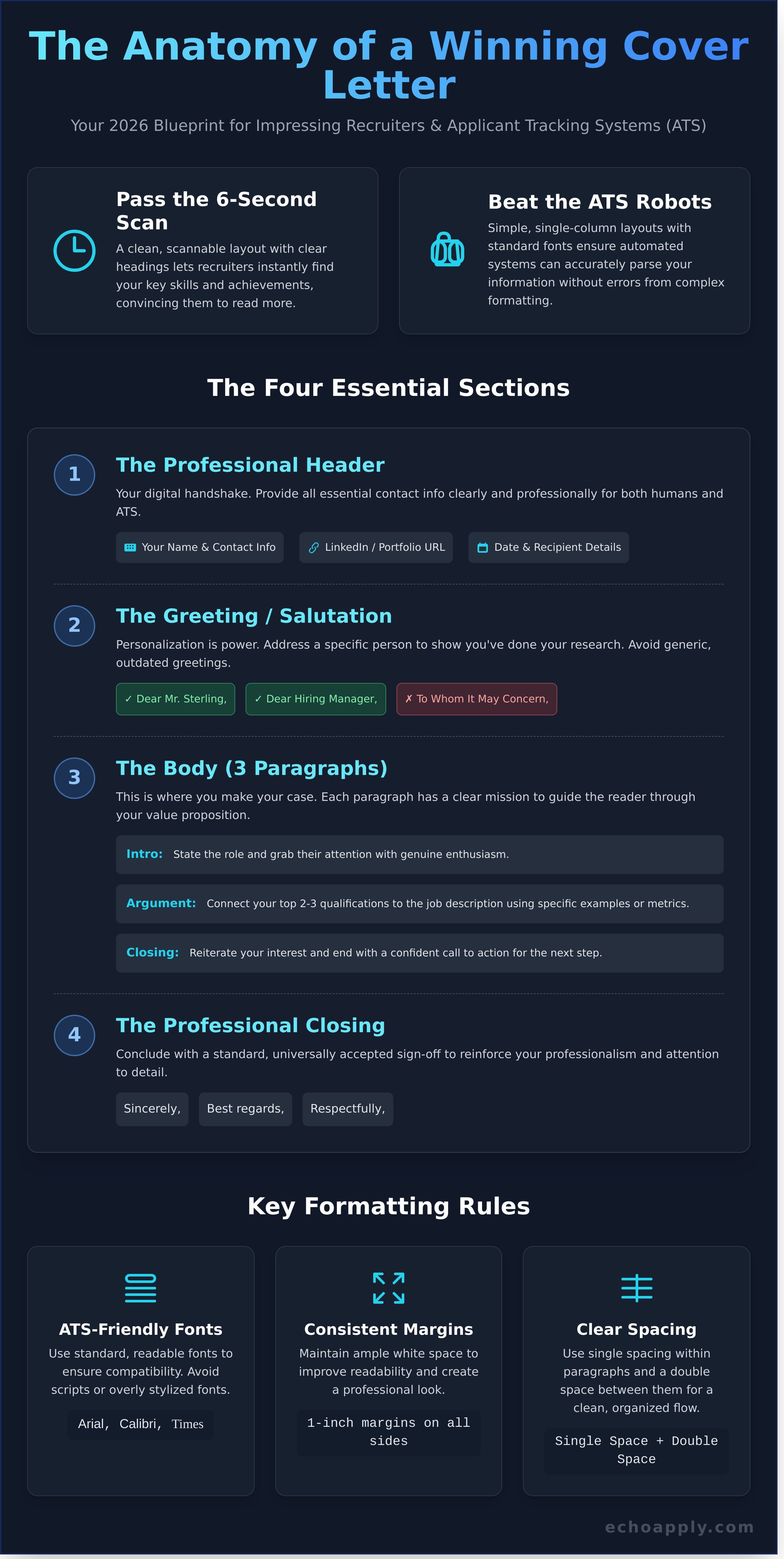
A winning cover letter is a strategic document, and its structure is just as critical as its content. Think of it as a blueprint for making a powerful first impression. Each section has a specific job, guiding the hiring manager through your career story logically and persuasively. Following this universal structure is the foundation of the best cover letter format because it ensures you deliver all essential information with professional polish and clarity.
Part 1: The Professional Header
Your header is your digital handshake-it must be clean, professional, and instantly provide all essential contact information. This section should be perfectly formatted for both human readers and Applicant Tracking Systems (ATS). A modern header, optimized for digital submissions, is a non-negotiable element of a successful application. This aligns with current National Careers Service advice, which emphasizes clarity and professionalism in digital correspondence.
- Your Information: Full Name, Phone Number, and a professional email address (e.g., firstname.lastname@email.com).
- Your Digital Presence: A clickable URL to your LinkedIn profile and a personal portfolio or website, if relevant to your field.
- Date and Recipient Details: The date of writing, followed by the Hiring Manager's Full Name, Title, Company Name, and Company Address.
Part 2: The Greeting or Salutation
Personalization is power. Always address your cover letter to a specific person whenever possible (e.g., "Dear Mr. Sterling," or "Dear Dr. Anya Sharma,"). A quick search on the company website or LinkedIn can often reveal the hiring manager's name. If the name is truly undiscoverable, use a respectful, modern alternative like "Dear Hiring Manager," or "Dear [Department] Team,". Avoid outdated and impersonal greetings like "To Whom It May Concern," which can signal a lack of effort.
Part 3: The Body (Introduction, Argument, Closing)
This is where you make your case. The body of the best cover letter format is typically three paragraphs, each with a distinct mission.
- The Introduction: Start with a powerful hook. State the exact role you are applying for and express genuine, specific enthusiasm for the opportunity and the company.
- The Argument (1-2 Paragraphs): This is your core pitch. Don't just list skills; strategically connect your top 2-3 qualifications directly to the key requirements in the job description. Use specific examples or metrics to prove your value.
- The Closing Paragraph: End with confidence. Reiterate your strong interest in the position and propose the next step with a clear call to action, such as, "I am eager to discuss how my expertise in project management can benefit your team."
Part 4: The Professional Closing
Conclude your letter with a professional sign-off that maintains the confident tone you've established. Standard, universally accepted closings are your strongest options. Choose a simple, elegant closing like "Sincerely," "Best regards," or "Respectfully,". Follow it with a comma, leave a few lines of space for a signature if sending a hard copy, and then type your full name. This final touch reinforces your professionalism and attention to detail.
Key Formatting Rules: Fonts, Margins, and Spacing
Beyond the words you write, the visual presentation of your cover letter sends an immediate, powerful message. These technical details-your font, margins, and spacing-are not minor points; they are strategic choices that create a polished, professional framework for your narrative. Consistency and clarity ensure your letter is instantly readable, allowing the hiring manager to focus on your value, not a cluttered page. Mastering these rules is a critical component of the best cover letter format.
Choosing the Best Font and Size
Your font choice communicates professionalism before a single word is read. To project confidence and clarity, stick to classic, universally readable fonts that are easy on the eyes. Overly decorative or casual styles can distract and undermine your message. Optimize for readability with these simple guidelines:
- Font Type: Choose a standard serif or sans-serif font. Top choices include Calibri, Arial, Helvetica, Georgia, and Times New Roman.
- Font Size: Use a size between 10 and 12 points for the body text. This ensures legibility on screen and in print.
- Emphasis: Make your name and contact information slightly larger (14-16 points) to create a clear visual hierarchy.
Setting Margins and Spacing
Strategic use of white space makes your cover letter inviting and scannable. A crowded page is overwhelming, but a well-spaced document guides the reader’s eye effortlessly through your key qualifications. Implement these settings for a clean, balanced frame that looks professional and intentional.
- Margins: Set margins to 1 inch on all four sides. This is the business standard and prevents the text from feeling cramped.
- Line Spacing: Use single spacing within your paragraphs for a compact, modern look.
- Paragraph Spacing: Add a blank line (a double space) between each paragraph and section to improve readability and flow.
Perfecting the Length and Layout
The goal is to deliver maximum impact in a minimal amount of space. Hiring managers are short on time, so precision is key. Adhering to standard length and alignment conventions shows respect for their time and reinforces your professionalism. The best cover letter format is always concise and direct.
- Length: Keep your cover letter to a single page. No exceptions.
- Word Count: Aim for a target of 250-400 words. This provides enough space to be compelling without being exhaustive.
- Alignment: Align all text to the left. This is the standard for business letters and ensures a clean, organized look from top to bottom.
Digital Submissions: Email vs. PDF Attachment Format
In today's competitive job market, your application will almost certainly be submitted digitally. This digital-first environment means the delivery method is just as important as the content itself. Navigating this landscape is a key part of selecting the best cover letter format for the role you want.
The two primary methods are attaching a file or pasting your letter into an email body. Each has distinct rules for success, but your first priority is to always follow the specific instructions in the job application. Deviating from their requested format is the fastest way to get disqualified.
The Gold Standard: PDF Attachments
When the application allows for attachments, a PDF is your most powerful and professional choice. It acts as a digital snapshot, perfectly preserving the layout, fonts, and spacing you carefully designed. This ensures your document looks exactly as intended on any device, from a recruiter's desktop to their phone.
To maintain a polished image, always use a strategic file-naming convention:
- Clear and Simple: FirstName-LastName-Cover-Letter.pdf
- Example: Jian-Yang-Cover-Letter.pdf
Formatting a Cover Letter for an Email Body
If an application asks you to paste your cover letter directly into the email, your strategy must shift to simplicity and readability. Forget the traditional header with your address and contact details; that information now belongs in your email signature at the very bottom. Launch directly into your message with a professional salutation (e.g., "Dear Ms. Alvarez,") and focus on clean, concise paragraphs that are easy to scan.
Writing a Compelling Email Subject Line
Before a hiring manager ever reads your letter, they see your email subject line. This is your first opportunity to signal that you are an organized, detail-oriented candidate. A vague subject like "Application" or "Cover Letter" is a missed opportunity. The formula for the best cover letter format via email is direct and informative:
Job Title You're Applying For - Your Full Name
For example: Application for Senior UX Designer - Priya Singh
This simple, clear structure makes your email instantly searchable and communicates your intent with professional efficiency. No matter the format, ensure your content is perfectly tailored. The EchoApply AI platform generates winning, customized content for any submission type, helping you create applications that get noticed.
Stop Guessing: Get the Perfect Format Instantly with AI
You’ve spent hours perfecting the content of your cover letter, only to get bogged down by the tedious details of formatting. Is the font right? Are the margins correct? Is there too much white space? Manually checking every rule is a time-consuming process where a single oversight can undermine your entire application.
In today’s competitive job market, perception matters. A simple formatting mistake, like inconsistent spacing or a hard-to-read font, can make you appear careless and unprofessional. It distracts the hiring manager from what truly matters: your skills and qualifications. Instead of focusing your energy on perfecting your message, you’re stuck wrestling with layout-a battle you don’t need to fight.
Modern tools empower you to bypass this frustration entirely. You can now ensure your presentation is flawless every single time, allowing your professional story to shine. It's time to stop letting formatting details hold you back and start leveraging technology to gain a competitive edge.
How EchoApply Eliminates Formatting Errors
EchoApply’s intelligent platform was built to transform your application from good to exceptional. Our AI doesn't just fill in a template; it strategically applies the best cover letter format based on proven industry standards and recruiter preferences. It instantly analyzes your content and structures it for maximum impact.
- Perfect Consistency: Our system ensures every element, from fonts and line spacing to margins and headers, is uniform and professional.
- Intelligent Layouts: We generate documents that are both ATS-friendly to pass through automated screeners and visually clean for human reviewers.
- Error-Free Guarantee: Eliminate the risk of human error and submit every application with the confidence that its presentation is flawless.
From Raw Skills to Polished Document in Seconds
Imagine transforming your raw skills and experience into a perfectly polished cover letter in a fraction of the time. With EchoApply, that efficiency is your new reality. Simply provide your details and the job description you are targeting, and our AI gets to work. It instantly generates a tailored document with the ideal structure, tone, and format.
Stop wasting precious hours adjusting tabs and margins. Reinvest that time into what truly drives your career forward: networking, researching companies, and preparing for the interviews you’re about to land. Your career deserves a strategic approach, not a manual one. Generate your perfectly formatted cover letter now.
Master Your First Impression with the Perfect Format
In the competitive job market of 2026, your cover letter's structure is your first handshake. A clean, professional layout isn't just about looking good-it's a strategic tool for making your qualifications instantly scannable for both hiring managers and Applicant Tracking Systems. Mastering the key sections, from your contact information to your closing, is non-negotiable for making a powerful impact and proving you're a serious candidate.
Ultimately, the best cover letter format is one that is clear, professional, and strategically designed to get you noticed. But why spend hours wrestling with margins and fonts when you can achieve perfection instantly?
Join thousands of successful job seekers who trust EchoApply to land more interviews. Our AI-powered platform generates perfectly tailored, ATS-optimized formats in seconds. Stop worrying about formatting. Generate a perfectly structured cover letter with EchoApply. Your next career move is out there. Ensure your application is engineered to win.
Frequently Asked Questions
How long should a cover letter be in 2026?
In 2026, the optimal cover letter length remains concise and powerful-under one page. Aim for three to four focused paragraphs, totaling between 250 and 400 words. This strategic length respects the hiring manager's time and proves you can communicate your value with precision. A lengthy letter gets skipped; a powerful, targeted message gets you noticed. This approach ensures your application is efficient, impactful, and perfectly tailored to the modern recruitment pace, giving you a competitive edge.
What is the best font to use for a cover letter to ensure readability?
The best font for your cover letter is one that prioritizes clean, modern readability. Choose a professional sans-serif font like Calibri, Arial, or Helvetica for a sleek look, or a classic serif font like Georgia for a traditional feel. Maintain a font size between 10 and 12 points to ensure effortless scanning on any device. Your goal is to eliminate any friction between your message and the reader, presenting your qualifications with sophisticated clarity.
Is it still necessary to include my full mailing address on a cover letter?
Including a full mailing address is an outdated practice. In today's digital-first hiring landscape, it's unnecessary and can clutter your header. Instead, adopt a modern, streamlined format: include your City and State, a professional email address, your phone number, and a link to your LinkedIn profile or online portfolio. This presents you as a technologically savvy candidate and directs recruiters to the platforms where your professional brand truly shines, making you more accessible and impressive.
How should I format a cover letter if I don't know the hiring manager's name?
Avoid the generic and impersonal "To Whom It May Concern." A more strategic approach is to address a specific role or department. Use a targeted salutation like "Dear Hiring Manager," "Dear [Department Name] Team," or "Dear [Job Title] Search Committee." This demonstrates initiative and a detail-oriented mindset, even with limited information. It’s a small adjustment that signals professionalism and helps your application stand out in a crowded, automated applicant tracking system.
Should my cover letter format match my resume format?
Yes, your cover letter and resume should be a perfectly matched set. Using the same header, font, and color scheme creates a cohesive and professional personal brand. This visual consistency makes your application memorable and easy to navigate. The best cover letter format is one that functions as a strategic partner to your resume, presenting a unified, polished package that signals meticulous attention to detail and reinforces your qualifications with powerful, streamlined design.
Is a two-column cover letter format a good idea?
While visually appealing, a two-column format is a significant risk. Many Applicant Tracking Systems (ATS) cannot parse multi-column layouts correctly, which can lead to your information being scrambled or your application being rejected before a human ever sees it. To ensure maximum compatibility and impact, the best cover letter format is a traditional, single-column document. This strategic choice guarantees your carefully crafted message is delivered intact, optimizing your chances of success.